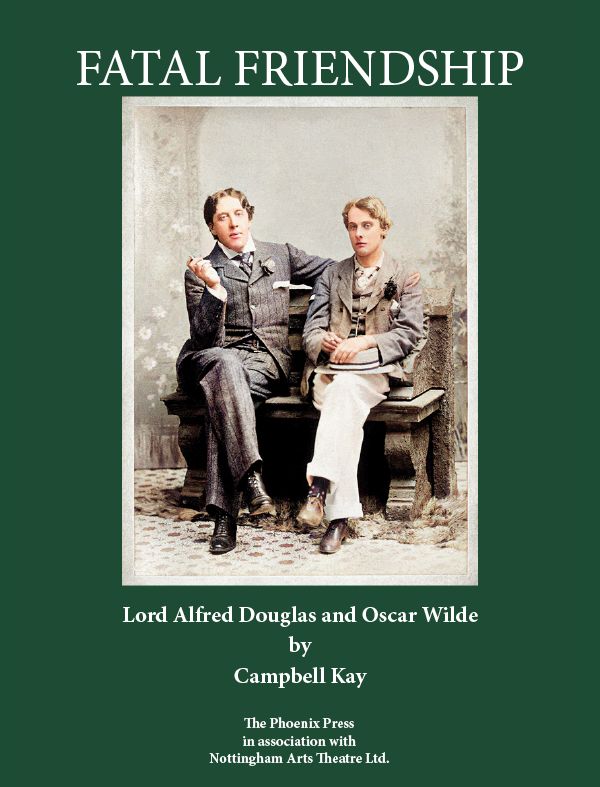
Fatal Friendship
“I saw... a very good opportunity of ending the fatal friendship that had sprung up between us... but I took you back.” - Oscar Wilde De Profundis
Abused from an early age by his mentally unstable father, the Marquess of Queensbury, and adored by his doting mother, Lord Alfred Douglas was a conflicted character. Although a poet, translator and author in his own right, Douglas has been forever associated with, and overshadowed by, Oscar Wilde.
Wilde’s greatest love, and greater nemesis, Douglas, perhaps unwittingly, destroyed his friend’s reputation and position in polite society. Queensbury’s illiterate accusation that Wilde was “posing as a somdomite” provoked a disastrous libel case, which, egged on by Douglas to take revenge on his father, and against the advice of his friends, Wilde chose to pursue. The trial unfortunately exposed Wilde to rumours, speculation about his sexuality and ultimately prosecution for “unnatural” proclivities.
Wilde’s guilty verdict and incarceration in Reading Gaol ruined his family life, destroyed his relationship with Douglas and for many years tarnished his literary standing.
The architect of his own misfortune, Douglas’s later life was dogged by a series of bitter ironies. He claimed, for instance, that Winston Churchill was part of a Jewish conspiracy to have The First World War general, Lord Kitchener, assassinated. Churchill, knowing the family and feeling sorry for Douglas, at first ignored the slur but, when Douglas republished it several times, felt he had to take action and sued for libel. Douglas promptly lost the case and was sent to gaol.
He later renounced his homosexuality, turned to the Catholic Church and married. Although the marriage produced a son, it was unhappy and short-lived. His wife abandoned him, his son was institutionalised and Douglas spent his final years living in genteel poverty with his beloved mother in Hove. In truth, Douglas could never escape his relationship with Oscar Wilde. For many years he denounced Wilde as a degenerate, who corrupted him and ruined his life, but, in middle age, Douglas became reconciled to the idea that he and Wilde were inextricably linked through love and friendship and he came to honour Wilde’s memory and his literary legacy.
This one man show, which examines the relationship between Lord Alfred Douglas and Oscar Wilde, is based on information gleaned from the biographies Bosie: The Story of Lord Alfred Douglas His Friends and Enemies by Rupert Croft-Cooke and Lord Alfred Douglas by H Montgomery Hyde and is devised from Douglas’s published works – his poems, letters and memoirs with specific reference to The Autobiography of Lord Alfred Douglas, Without Apology and Oscar Wilde: A Summing Up. In addition to Douglas’s writings, use has been made of Oscar Wilde’s publications, court transcripts and the reminiscences of their friends and contemporaries. Lord Alfred Douglas was clearly a contradictory character – a beautiful youth prone to ugly fits of temper; a self-confessed pagan who converted to Catholicism; a chauvinistic Scotsman educated and living in England. He was also eccentric, obsessive, conceited and given to self-dramatisation, in fact, all too human. It is hoped that this portrait of Douglas is, at least, a fair one for he was often misunderstood by his contemporaries and has either been castigated or, at best, tolerated by Oscar Wilde’s biographers.
Living in straitened circumstances, with his adored mother in 1930s Hove, Lord Alfred Douglas, by his own admission “once the most handsome man in England”, is enduring a hand to mouth existence. His hopes of financial rescue rest on the American publication of his autobiography for which he has asked an old friend, George Bernard Shaw, to write the preface. When Shaw refuses, and suggests it would be better if he, and others would refrain from “writing about Oscar”, Douglas offers a strenuous defence of his turbulent life and his troubled relationship with Wilde.
Performance Details
Fatal Friendship: Lord Alfred Douglas and Oscar Wilde was first presented by Eastwood Productions in association with Nottingham Arts Theatre at Nottingham Arts Theatre on 13th October1995 with the following cast:
Lord Alfred Douglas - Nic Adams
The play was directed by Campbell Kay
Praise for Fatal Friendship
“Fatal Friendship is made more powerful by the presence of Nic Adams as Lord Alfred. By turn reflective, humorous and trenchant, impersonating everyone from Wilde to a rent boy on the way, Mr Adams gives an impressive performance. Campbell Kay’s writing and direction ensures a variety of pace, colour and movement that keeps the monologue constantly engaging.” - Nottingham Evening Post
“Campbell Kay’s Fatal Friendship offers a spirited defence of Lord Alfred Douglas’s relationship with Oscar Wilde. In this well-written play, Douglas challenges the popularly held view that he “ruined” Wilde and, in a detailed and frank confession of his sexuality and beliefs, he invites a modern audience to confront their own prejudices .” - BBC Radio