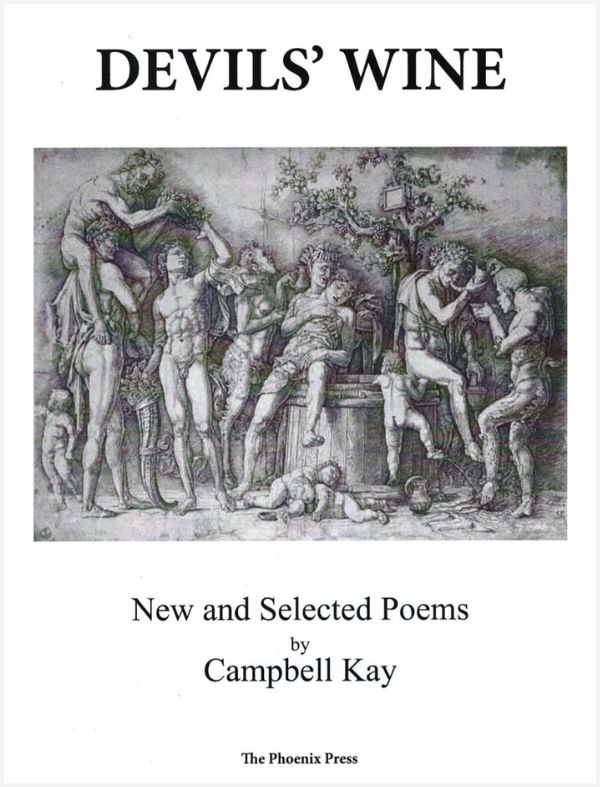
Devils' Wine
Exploring the themes of love, life, loss and loneliness, the poems in Campbell Kay's collection - Devils' Wine - are accessible and intelligible. In the language of his native land, Kay is a 'makar', an old Scots word describing someone who crafts, creates, constructs and makes poems. Thus his poetry has a solidity and substance which communicates its meaning with clarity and lyric skill.
Yet Kay's poetry is not all that it might appear to be on the surface. Beneath the seeming conventionality of form, meter, rhyme and rhythm, there is a sly, sinister and subtle subversiveness at work. Kay suggests that, love, in all its varieties, is dogged by complexities, that childhood is not quite so innocent, that life in the twenty-first century is less than simple, and the world is not quite so ordered as the construct of his verse might suggest. It is this dichotomy, diversity and duality of human experience that Kay's poetry dissects and celebrates.
Praise for Devils' Wine
"Mr Kay has an accomplished lyric style. Most poems rhyme and follow relatively formal meter, Mr Kay is also a romantic. Many of his poems refer to love in one way of another... There are some good poems. Like perhaps most creatives Mr Kay seems at his most effective when he is writing from a position of vulnerability. For example this stanza from The Death of Love written after the narrator's love breaks up with him:
I wish that I could make you love
With such intensity and pain;
Then tell you it was not enough
That giving all was all in vain.
I like this a lot. There is a wounded, vindictive honesty to it, an economy of cleverness to the wordplay. Making love has never seemed so sinister, so manipulative (although to be fair I have yet to read Fifty Shades of Grey). I honestly don't think I've seen it in this context before. Basically he's saying "I want make you love me as much as I love you so when I end it with you you will know exactly how I felt when you ended it with me." This is a sentiment so wonderfully complex, it could have been an early 70's Fleetwood Mac song and it was beautifully expressed... There is some consistent work on offer for those who like traditionally structured poems on tradition themes."
Review by Andrew Barber published on Pulsar Poetry Webzine Edition #13 (65) December 2012
Selected poems from Devils' Wine
Love In Venice
Venice on a rainy day;
San Marco shrouded in the mist;
While phantom waters swell and spray
The gondolas where lovers kissed.
Serenissima silent - suddenly dumb.
Beneath a dark and foggy pall,
The muffled vaporetti come
To moorings on the Grand Canal.
Lost in a labyrinth of streets,
We stumble on a small café;
Order Campari Bitter - neat -
And watch the ice cubes melt away.
We smile, and each smile understands,
Such moments are too rare to pass.
We hold love, fragile, in our hands,
As precious as Murano glass.
Wishing On The Moon
I
The midnight moon is bleary eyed,
A drunkard staggering through the night;
While candles on the window ledge
Provide a pallid, faltering light.
II
Crazed as the moon, I feel the chill
Of fifty winters on my back
And hoard my meagre score of years,
Fearful of the time I lack.
III
Like echoes from a distant room,
Your naked footsteps cross the floor.
Draw back the coverlet of dreams
And you are in my arms once more.
IV
No songbird hymns the break of day,
Dead candles greet an empty dawn.
Such certainty we have in dreams,
My arms reach out and you are gone.
Celia Among The Pigeons
Pigeons, plump as aldermen,
Strut across Old Market Square
Nodding at acquaintances,
Who seem to greet them everywhere.
Celia smiles. To her, it seems absurd
That such a silly, homely bird
Should stick its chest out with such pride
And try to look so dignified.
She offers them some dry white bread,
Or birdseed if they want that instead.
The pigeons look. Their heads incline,
But bread, and birdseed, they decline.
Each pigeon hurries on its way;
We've lots to do, they seem to say,
Today is such a busy day,
Tomorrow we might stop and play.
To A New Born Child
Come crying here to take your place,
With solemn eyes and puckered face.
Your breath, like softly beating wings
To which our hope and sorrow clings,
Speaks of beginning, like the first word
That scattered darkness from the world.
You'll wake to walk by lakes and shores,
To view, with wonder, fields and stars,
To know the precious worth of things,
And feel the hope that soars and sings;
While we, of our innocence beguiled,
Will envy your secret joys and smiles.